Print on Demand platforms have transformed how creators launch products, offering scalable, low-risk opportunities that let designers test ideas, refine designs, and ship orders directly to customers without tying up precious capital in inventory, making it feasible to experiment with niche audiences and seasonal collections. Many sellers start with ecosystems that balance branding, customization, and ease of use, and Shopify print on demand embodies this blend by providing a customizable storefront, built-in payment options, rapid setup, strong security, and a broad app ecosystem to optimize marketing, analytics, and order management. Other routes, including marketplaces and all-in-one platforms, expose your work to different audiences and can accelerate early traction, but they also shape how you control branding, pricing, customer service, and fulfillment timelines, often requiring compromises between reach and hands-on store management. When evaluating options, focus on production speed, product catalog breadth, print quality, and how well a given solution integrates with your existing tools and workflows, because the most important choices are the ones that align with your business model and long-term growth plan. This guide walks you through the essentials—cost, speed, quality, and partnerships—so you can pick a POD approach that matches your vision, audience, and growth trajectory, and remains adaptable as trends and technology evolve.
Understanding Print on Demand Platforms: Core Mechanics and Benefits
Print on Demand platforms are services that handle product creation, printing, and shipping on demand when a customer places an order. They offer low upfront costs, eliminate inventory risk, and let designers test multiple designs and niches quickly—hallmarks of the broader merchandise printing services space.
The typical workflow involves designers uploading artwork, selecting a product catalog (from t‑shirts to wall art), and connecting the storefront to production partners. This setup enables rapid experimentation with product lines while preserving branding consistency across channels, whether you’re running a standalone store, a marketplace presence, or a hybrid model using a platform like Shopify for design and order management with a partner handling printing and fulfillment.
Shopify print on demand vs Etsy print on demand: Aligning Your Brand with the Right POD Approach
Shopify print on demand offers strong branding control, a customizable storefront, and full access to customer data through a robust ecosystem of apps. When paired with a Printful integration, you can push designs across a wide product catalog, preview proofs, and manage orders from a single dashboard. This level of control—brand, pricing, and checkout experience—comes with a trade-off in setup time and ongoing management costs.
Etsy print on demand, by contrast, leans into built-in marketplace traffic and a discoverable, giftable vibe. It’s often simpler to launch because you’re leveraging an established audience and the Etsy search algorithm. However, you trade off some storefront branding control and direct customer data. Printful integration with Etsy helps automate listing creation and fulfillment, making it easier to validate designs quickly while maintaining a consistent customer experience.
Maximizing Fulfillment Quality with Printful integration
Printful integration is a cornerstone for many POD businesses due to its broad product catalog, global fulfillment network, and reliable automation. With a strong Printful integration, you can push designs to a wide range of product categories, ensure consistent print quality, and automate order routing to preferred facilities, which is essential for scaling.
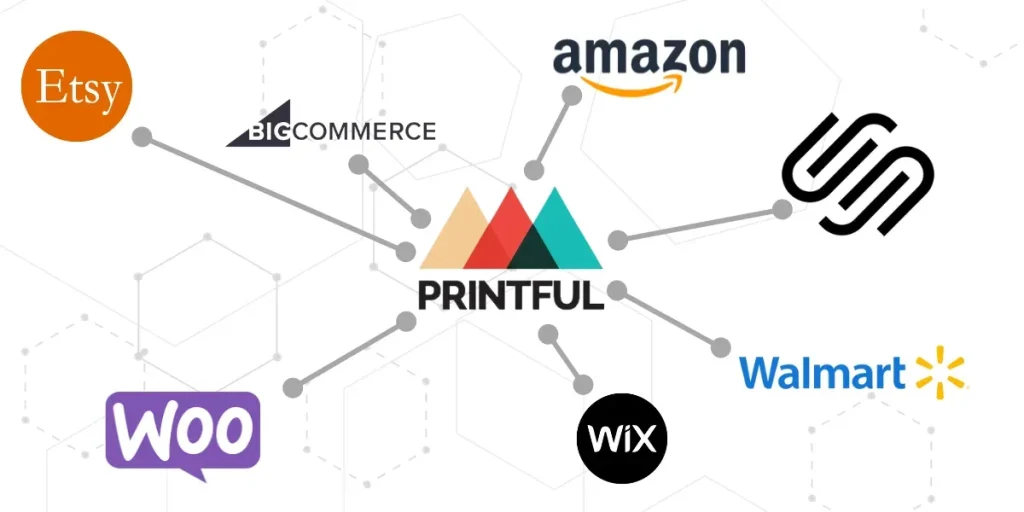
The advantage of multi‑channel connectors is the ability to keep product data in sync across storefronts, manage orders from multiple channels in one dashboard, and deliver uniform branding and packaging. By relying on Printful integration, merchants can reduce manual tasks, shorten turnaround times, and improve overall customer satisfaction as you expand into new markets or product lines.
Print on Demand platforms compared: Balancing cost, speed, and scalability
POD platforms compared come down to three pillars: cost, speed, and quality. Assess product base costs, fulfillment fees, and shipping estimates across regions, as well as any platform subscriptions. While Shopify may incur monthly fees, Etsy often takes a larger share of profits via listing fees and commissions. Printful and similar providers price each item by variant and destination, so it’s wise to run sample orders to understand true landed costs.
Turnaround times vary by product type, production facility, and shipping method. A multi‑center fulfillment strategy can dramatically improve delivery speed to key markets. When evaluating POD platforms, also consider where you’ll scale—how easily you can automate workflows, manage orders from multiple storefronts, and maintain a consistent brand experience as you grow.
Merchandise printing services and multi-channel strategies for growth
Merchandise printing services sit within a broader category of on‑demand production, offering options that extend beyond single platforms. This perspective helps you evaluate total cost of ownership, supplier reliability, and product variety as you plan multi‑channel strategies across Shopify, Etsy, and other marketplaces.
A practical growth plan includes starting with a niche, testing designs with sample orders, and automating fulfillment across channels. Consider SEO and discovery strategies on marketplaces, and design your storefronts for a cohesive brand experience. By combining a thoughtful hybrid approach—leveraging the best of Shopify print on demand, Etsy print on demand, and Printful integration—you can scale efficiently while maintaining control over brand and profitability.
Frequently Asked Questions
Shopify print on demand vs Etsy print on demand: which option is best for brand control and growth?
Shopify print on demand offers full branding control, customizable checkout, and rich app support for scaling a direct-to-consumer store. Etsy print on demand gives built-in traffic and easier setup but with less control over branding and customer data. Consider your need for branding, data ownership, and ongoing costs; a Printful integration can extend product catalogs across both platforms while keeping fulfillment centralized.
How does Printful integration influence fulfillment speed and accuracy across Shopify print on demand and Etsy print on demand?
Printful integration automates product syncing and fulfillment for both Shopify print on demand and Etsy print on demand, reducing manual work and enabling consistent production across channels. It helps streamline order routing and inventory management, but check regional lead times and order a sample to verify print quality.
What factors should you consider when POD platforms compared for multi-channel selling?
When performing POD platforms compared for multi-channel selling, weigh branding control, product catalog breadth, pricing, and fulfillment speed. Also assess automation, cross-channel data syncing, and analytics to scale efficiently.
Are merchandise printing services a viable alternative to standard POD platforms?
Merchandise printing services can complement or substitute POD platforms when you need unique products or different fulfillment options. Evaluate setup costs, minimums, product quality, and integration with your storefront to determine the best fit.
What criteria should you use when POD platforms are compared to evaluate cost, speed, and quality?
When POD platforms are compared, focus on total cost (base price, fulfillment, and platform fees), production speed, and print quality. Order samples, test multiple products, and consider regional shipping times and scalability for long-term growth.
| Key Point | Summary | Notes |
|---|---|---|
| What are Print on Demand platforms? | Definition and core benefits/challenges | POD services handle product creation and shipping on demand; benefits include low upfront costs and no inventory; challenges include balancing quality, speed, and cost, plus storefront setup and fulfillment considerations. |
| Choosing a focus for your comparison | Control vs speed to market | Brand control (Shopify) vs reach (Etsy) versus multi-channel convenience (Printful integration); considerations include setup time and ongoing management. |
| Shopify vs Etsy vs Printful integration | Strengths and trade-offs | Shopify offers branding and data ownership; Etsy provides marketplace traffic; Printful enables automation across channels; weigh costs, flexibility, and complexity. |
| Cost, speed, and quality pillars | Three dimensions to compare | Costs include base price, fulfillment, shipping; speed depends on production and shipping; quality requires testing and clear standards. |
| Branding and scalability considerations | Branding impact as you scale | Shopify offers strong branding control; Etsy is simpler branding; Printful supports consistent fulfillment; plan for automation and analytics. |
| Choosing the right path for your business model | Tailor strategy to goals | If branding is key, prefer Shopify; for quick validation, Etsy; for multi-channel, Printful integration; hybrids like Shopify + Printful balance control and convenience. |
| Practical tips for success | Actionable ideas | Niche focus, rapid prototyping, automation, SEO optimization, margin monitoring, multi-channel planning. |
Summary
Print on Demand platforms empower creators to launch and grow product lines without carrying inventory. By combining options like Shopify print on demand, Etsy print on demand, and Printful integration, you can tailor a storefront strategy that fits branding, reach, and fulfillment needs. The right mix supports low upfront risk while enabling testing across designs, niches, and markets. For multi-channel success, prioritize product quality, reliable shipping, and clear customer communication, and use automation to scale as demand grows. Remember to evaluate cost, speed, and quality as you choose your approach—the trio that determines long-term profitability and brand consistency across Print on Demand platforms.